Field Guide Quick-Start

Start here.

Three steps, in order: take your baseline Score, install the guide in one sitting, then run three simple rituals. Below is the whole path — with a filled-in example for every section. The book and the course go deeper; this gets you running today.

Pick your edition — the ideal-week example adjusts to your clock.
The Path

Three steps, in order.

Set it up once, then run three rituals. Do them in this order — the first takes ten minutes, and everything after it measures against that number.

1
First · before you install anything

Take the Score — your Day-1 baseline

Sixteen honest questions, about ten minutes. The number you get is your baseline — the fixed point you'll measure every cycle against. Take it now, before you build a single page. It's the same Score you'll re-take at each Cycle Reset, so you can see real movement in writing. In your guide it's printed as The Night Audit (NightOS) / The Day Audit (DaytimeOS) — same sixteen questions, same 32-point scale. Do it here or there; it's one number.

2
Once · one focused sitting, on your clock

The First Night · The First Morning — install the guide

Work the front of the guide once, in order: your four foundations — Life Arc, Identity, Operating Standards, Compass — then open your first quarter. Install, don't perfect; you build it once and sharpen it at every Reset. See the six-step sitting ↓

3
From here on · the system runs you

Run the three rituals

Each day, the Rhythm Method and one protected Peak Block. Each week, the Weekly Engine. Each month, a Month in View. That's the whole operation — printed on every spread, so you never have to remember it. See the rituals ↓

Every quarter

The Cycle Reset — re-take the Score

Debrief in facts, re-take the same Score beside your Day-1 baseline, read the trail — then choose the next quarter, on purpose. Measured movement, not a feeling, is the whole point of running a standard.

The whole thing in four layers

Personal OS is one system stacked top to bottom. Higher layers govern the ones below — so you build in order, and never tune a layer while the one above it is hollow. Identity (who you are) → Direction (where you're going) → Cadence (your rhythm) → Execution (what you do today).
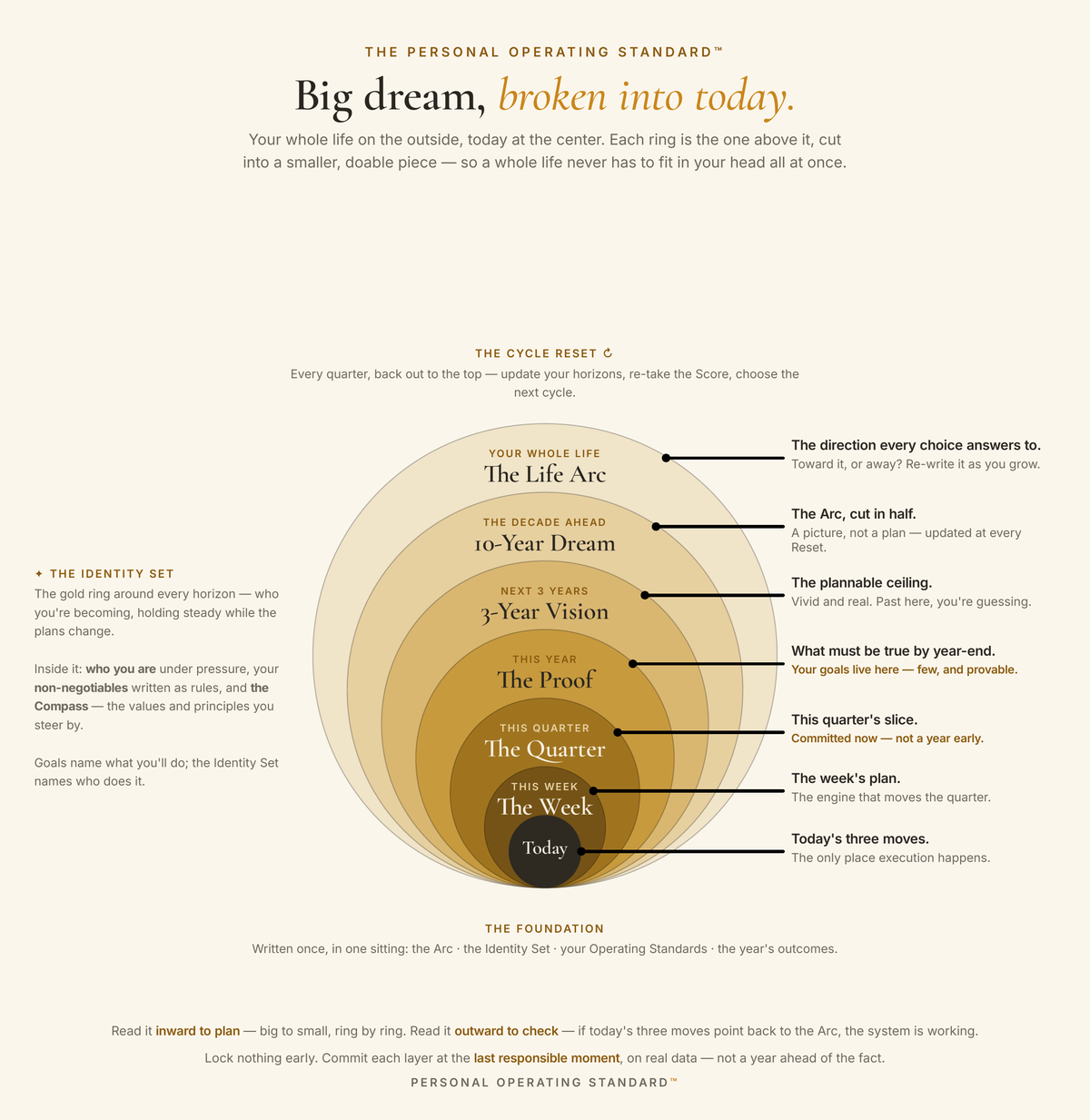
The Personal Operating Standard system map — from your Life Arc down to today
The whole system on one page — your Life Arc narrows through the decade, three years, and this year down to today. Read it inward to plan, outward to check.

Your first sitting — The First Night · The First Morning (one focused sitting, on your clock)

Work the front of the guide once, in order. Install, don't perfect — you'll sharpen every page at your first Cycle Reset. You'll revisit it often — but you only build it once.

  1. Write your Life Arc — including ten / three / this year in broad strokes — and your Identity.
  2. Set your Operating Standards and Compass.
  3. Name This Year's Proof — the few outcomes that make this year undeniable.
  4. Choose your three domains (default: Work · Create · Life — rename them to fit your life), your accountability, and the anchors that don't move.
  5. Zone My Designed Day — peak · trough · rebound — and lay out your Designed Week.
  6. Open the cycle at The Quarter — three objectives, weekly leads, and what you're not doing.

That's The First Night (day-peakers: The First Morning). From here, the whole system is three rituals.

Layer 1 — Identity · who you are

Life Arc

The end-state your life is aimed at. Write it as if looking back from the end — what must be undeniably true?

Life Arc — looking back from the endExample
At the end it’s undeniable: I built a family that stayed close, work that helped people, and a body that carried me — present for the people I love, not just busy near them.

Identity

Who you are in four lines: your Core (who I am), Operating (how I live), Decision (what I choose under pressure), and Override (what I do when stuck).

Identity — four linesExample
Core — who I amA builder and a steady presence.
Operating — how I liveI do hard things early.
Decision — under pressureI protect my word and my health.
Override — when stuckShrink it to one 20-minute block.

Operating Standards

Your standards as constraints — what you refuse to do, what you always do, and how you enforce each one. This is the heart of the standard.

Operating Standards — constraints you enforceExample
I nevercheck my phone before my first deep-work block.
I alwaysshut the laptop by 6pm and eat dinner with my family.
Enforced bythe phone charges in the kitchen overnight.

Compass

The governing values and principles you steer by — your yes and your no in a few words.

Compass — your yes and your noExample
Values: faith, family, craft, health.  ·  Principle: slow is smooth, smooth is fast.
Layer 2 — Direction · where you're going

10-Year Dream

The decade as a picture, not a plan — written present tense, as if you're living it. A dream you re-read and re-write at every Reset, not a promise you're locked to. Broad strokes already live on your Arc; this is where they get their depth.

10-Year Dream — present tenseExample
The business runs without me in the room. We travel a month a year. My kids still call to talk, not just to ask for things.

3-Year Vision

The plannable ceiling — close enough to picture, far enough to matter. Vivid and real; past here you're guessing. This is the farthest out you actually plan against.

3-Year Vision — present tenseExample
The first book is published — real, out in the world. The business clears its number with a team, not just me. I've held my peak block three straight years.

This Year

One page, two moves. First picture the year present-tense, as if it's already here. Then make it checkable: five proof conditions — “by year-end, X is true,” not a task list — plus what you're not doing. Each proof condition becomes one of the few goals below.

This Year — picture, then proofExample
In one yearthe work is mine and it’s working — and I didn’t steal an evening from my family to get here.
By year-endthe business nets its target without my daily involvement.
By year-endI’ve kept every Sabbath.
By year-endI can do ten strict pull-ups.
Not doingno new client types this year.

Goals

For each goal: why it matters, what done looks like, the quarterly breakdown (each quarter ships a real outcome), your weekly lead measures, obstacles & if-then plans, and your next step.

Goal — worked exampleExample
GoalFinish & publish my first book by Dec 31.
Done looks likeEdited, formatted, listed for sale.
This quarterOutline + first three chapters.
Weekly lead measureFive 45-minute writing sessions.
If-thenIf I travel, then I write 20 min first thing.
Next stepDraft the outline tonight.
Layer 3 — Cadence · your rhythm

The Designed Week

Block your week at your peak. Fixed anchors (family, rest, your deep-work block) plus protected time for what matters. A map, not a prison. Zone My Designed Day once — peak · trough · rebound — and set the anchors first.

Here’s a full ideal week for your edition — peak blocks land where your brain actually peaks. Same standard, different clock. Use the toggle up top to see the other one.

A day-peak ideal weekDaytimeOS
Peak / deep workAnchors — family, rest, worshipSupport & admin
A night-peak ideal weekNightOS
Peak / deep workAnchors — family, rest, worshipSupport & admin

The Rhythm Method & the Restart Rule

The daily ritual, printed on every spread — Close the Day · Set Tomorrow · Prime the Mind (the Night Rhythm Method™ on NightOS; the Evening Rhythm Method™ on DaytimeOS) — plus one protected Peak Block. And the rule that keeps it alive: missed once is data, twice is friction, three times — change the environment. A miss is never a zero.

ExampleClose: one win — shipped the outline; one lesson — start the ramp earlier. Set: tomorrow's Three, pulled from this week's leads. Prime: "I finish what I protect." Missed last night? One line tonight still counts — never a zero.
Layer 4 — Execution · what you do today

The Quarter — your living dashboard

Open the cycle: a theme, three objectives, the weekly lead measures that move them — and what you're not doing this cycle. Then it stays open: the cycle trail is twelve small boxes where each week's Velocity lands, so the whole quarter is visible on one page.

ExampleTheme: Foundations. Objectives: ship the book draft · twelve weeks of strength · a real date night weekly. Leads: five writing sessions, three lifts. Not doing: the new podcast. Trail so far: wk 1 — 14/21 ✗ · wk 2 — 17/21 ✓ · wk 3 — 18/21 ✓.

The Daily Spread

Run & reflect on the left: your protected Peak Block — one Deep Thing, Protect → Ramp → Run → Land — then your Three, one move each across your three domains (default Work · Create · Life), what you're saying no to, the Rhythm Method box — Close · Set · Prime — and the bottom row: Three done, cooldown, one friction cleared for tomorrow. Agenda & capture on the right, with More to do — after the Three, notes, and the Never a Zero box.

The daily spread — a real nightExample
Peak Block · One Deep ThingChapter three — the villain scene. Protect ✓ Ramp ✓ Run ✓ Land ✓
1 · WorkSend the proposal — final read.
2 · CreateDraft 800 words of chapter three.
3 · LifeCall Dad — no agenda.
Saying no toNew requests after 9 pm.
Rhythm · CloseWin: outline shipped. Lesson: start the ramp earlier.
Set · tomorrow’s ThreePulled from this week’s leads ✓
Prime“I finish what I protect.”
Bottom rowThree done 3/3 · Cooldown ✓ · Friction cleared: clothes laid out, file queued.
Right pageAgenda · More to do — after the Three · Notes · Never a Zero: one line still counts.

The Weekly Engine

Fifteen honest minutes at week's close. Read the gaugesVelocity (Three done, out of 21) and Charge (cooldowns kept, out of 7, with a trend arrow) — tick Shared, then the On-Standard bar: Peak 5+/7 · Three 17+/21 · Engine run · Anchors kept. Name the drift in one sentence, make the smallest fix, process your captures (do · schedule · file · drop), and transcribe Velocity to the cycle trail on your Quarter. Then turn the page to The Week Ahead.

ExampleVelocity 17/21 · Charge 5/7 ↑ · Shared ✓ (sent to Sam) · On-Standard ✓. Drifted on sleep — smallest fix: phone charges in the kitchen. Captures processed; wk 3 box on the trail: 17.

The Week Ahead

The plan-forward page. Pull it all in — sweep last week's loose ends, this week's dates from your month pages, and your quarter's objectives — then write it all down and choose three targets (three, on purpose: more than three and none of them ship). Block them into the week across Mon–Sun, and set the first day — its Three get written on that day's page, not twice.

ExampleSwept in: two carry-overs, a Thursday deadline, Q-obj 1. Targets: chapters 4–6 drafted · hire a closer · lock the write block. Blocked: writing Mon/Tue/Thu nights, closer calls in the afternoon.

Month in View

Three undated month spreads map your cycle. Anchors that don't move go in first — family, rest, the blocks work can't take — then dates, key marks, and the habits you’re holding.

The Cycle Reset — the Finish

Twelve weeks in: re-read your Arc, debrief in facts, re-take the Score beside your Day-1 baseline, read the trail — then choose the next quarter, on purpose. Movement in writing, not a feeling.

ExampleBaseline 34 → now 47. Biggest gap: Cadence. Next cycle's theme: Deepen — same three domains, new leads.

Three rituals, once you're installed

Each day

Run the Rhythm Method — Close · Set · Prime — plus one protected Peak Block. Ten minutes at your close-of-day.

Each week

The Weekly Engine — Velocity & Charge, one smallest fix, and the On-Standard bar. Fifteen honest minutes.

Each month

Open a Month in View; set anchors and habits.

Each cycle

The Cycle Reset — re-take your Score, read the movement in writing, choose the next quarter.

Using your edition

Digital

Import the PDF into GoodNotes, Notability, or Noteshelf. Tap the Contents page or your app's bookmarks to jump anywhere. Write in edit mode; navigate in view mode.

Printed & Binder

The binder edition is loose-leaf and hole-punched for a 6-ring A5 binder; the bound edition reads like a book. Both run the same system, front to back.

Printing your digital edition at home

The digital guide is a true A5 book, laid out in spreads — your daily run-sheet on the left page, agenda and capture on the right. Three settings keep it that way on paper:

  1. Paper size — A5 (148 × 210 mm). If your printer takes A5, set the size to A5 and scale to 100% / Actual size for the exact designed proportions. If it doesn’t, choose Letter or A4 and select Fit (Scale to fit) — you’ll get a slightly larger book with wider margins, same layout.
  2. Two-sided, flipped on the long edge. The pages are built as facing spreads, so double-sided long-edge printing keeps each left/right pair together. Single-sided prints fine too — the pages just won’t face each other.
  3. Portrait orientation, color on if you can — the accents and covers use it. Grayscale still reads cleanly.

Prefer a ready-made, hole-punched book? The Binder edition is built with offset margins for a 6-ring A5 binder — no trimming or guesswork.

Ready to run it?

Get your Field Guide

New here? Step 1 is the same for everyone — the free Score takes ten minutes and becomes your Day-1 baseline. Take the Score →